All birds Sandpipers and Allies
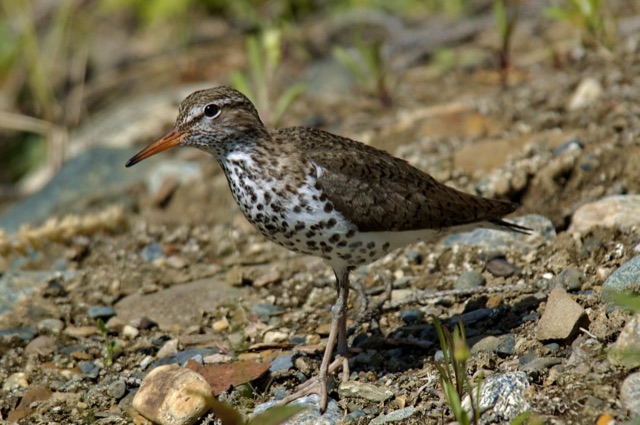

Spotted Sandpiper
Actitis macularius
Passes through in April to May and again in August to September.
Recorded by Paul Marvin. CC BY-NC-SA 4.0, via xeno-canto, trimmed and volume evened out.
Look for
- In spring, round black spots cover its chest and belly.
- A thin bill that's mostly orange, with a black tip.
- As it walks, it bobs the back half of its body up and down. That's why some people call it the "teeter-peep."
A little about it
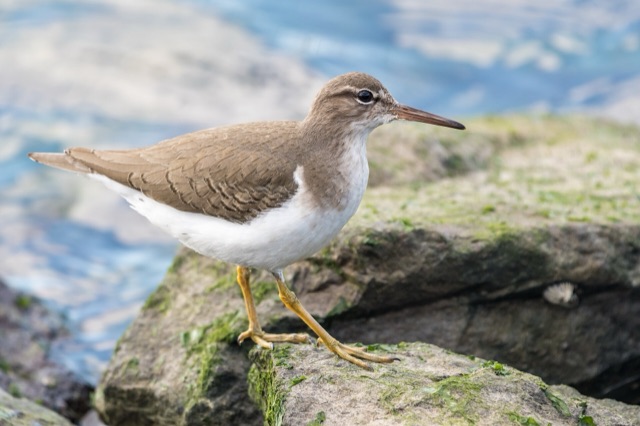
Spotted Sandpipers pass through here twice a year. Look for them in April and May, and again in August and September. In fall they look plainer, so watch for a white wedge that pokes up in front of each wing.
It eats lots of kinds of bugs, plus worms, crayfish, and small fish. It picks food off the ground or the water. Sometimes it creeps low and slow, then dashes forward to grab a bug.
If you scare one, it flies off low over the water. It flaps fast, then glides on stiff wings. Listen for a clear "peet-weet!"
The mother is a little bigger than the father, and she's much bossier. She lays the eggs, and the father keeps them warm and raises the chicks. Then she may lay more eggs with another male.
Fun fact
The fuzzy chicks start the bobbing walk almost as soon as they hatch. They find their own food, and their dad watches over them.
When it's here
- January: not here
- February: a few
- March: not here
- April: here
- May: here
- June: not here
- July: here
- August: here
- September: here
- October: a few
- November: a few
- December: a few
Taller bars mean more sightings. Most often seen in May.
How big
About 7 to 8 inches, with wings 13 to 15 inches across. A little bigger than a sparrow.
Where to look
Pebbly shores of lakes and ponds, and the banks of creeks. Look for a small bird walking alone at the water's edge, bobbing as it goes.
People have spotted it at Lake Overholser, Arcadia Lake, Lake Stanley Draper.
Could it be something else?
Killdeer
It hunts at the water's edge too. A Killdeer is bigger and has 2 black bands across its chest. It also lives in fields and on lawns far from water.
More photos
Where these facts come from
- Oklahoma Department of Wildlife Conservation field guide
- Audubon Guide to North American Birds
- When it's here: Sightings shared on iNaturalist in the 8 counties, all years.