All birds New World Sparrows
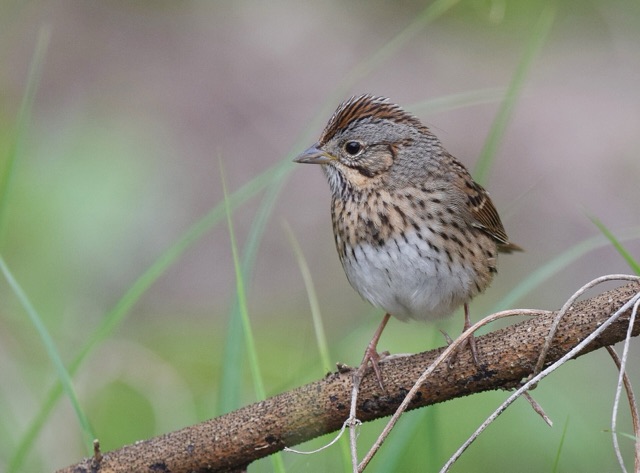

Lincoln's Sparrow
Melospiza lincolnii
Passes through in March to April and again in October to November.
Recorded by Davyd Betchkal. CC BY-NC-SA 3.0, via xeno-canto, trimmed and volume evened out.
Look for
- A tan chest with thin black streaks.
- A gray stripe over the eye, with brown cheeks and a brown cap.
- A tan stripe below the cheek, like a thin mustache. Males and females look alike.
A little about it
Lincoln's Sparrows pass through here in spring and fall. Look for them in March and April, then again in October and November. October has the most.
This sparrow is shy and hides in thick, low plants, so lots of people never notice it. It usually stays by itself and doesn't join flocks. Listen for its call, a hard "chep" from inside the bushes.
It hops on the ground near thick bushes to find food. In summer it eats lots of bugs, like caterpillars and ants. In winter it eats lots of seeds from weeds and grass.
In summer, it nests up north and high in the mountains, in thick, low plants near water. The nest is on the ground, well hidden under grass or bushes. The female lays 4 or 5 pale green eggs with reddish brown spots.
Fun fact
A mother Lincoln's Sparrow may sit still on her nest until danger is very close. Then she scurries away along the ground like a mouse.
When it's here
- January: here
- February: a few
- March: here
- April: here
- May: a few
- June: not here
- July: not here
- August: not here
- September: a few
- October: here
- November: here
- December: a few
Taller bars mean more sightings. Most often seen in October.
How big
5 to 6 inches. About as big as a sparrow.
Where to look
Thick bushes and weedy, overgrown fields. Look low, on the ground close to the bushes.
People have spotted it at Stinchcomb Wildlife Refuge, Myriad Botanical Gardens, Martin Park Nature Center.
Could it be something else?
Song Sparrow
Its streaks are thicker, and they often run together into a dark spot in the middle of the chest. A Lincoln's Sparrow has thin black streaks on a tan chest.
Where these facts come from
- Audubon Guide to North American Birds
- When it's here: Sightings shared on iNaturalist in the 8 counties, all years.