All birds New World Sparrows
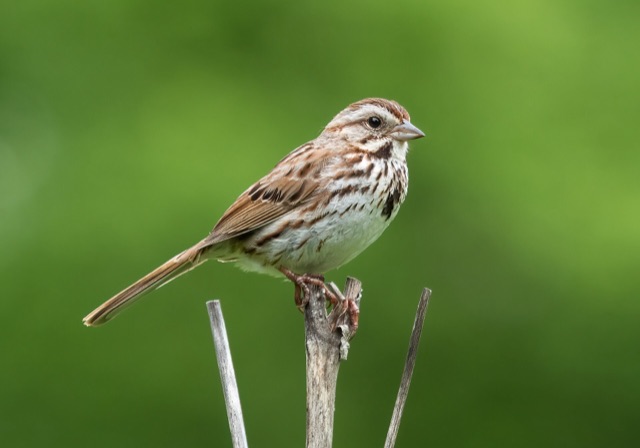

Song Sparrow
Melospiza melodia
Here October to April.
Recorded by Greg Irving. CC BY-NC-SA 4.0, via xeno-canto, trimmed and volume evened out.
Look for
- Thick brown streaks all over the chest and sides.
- Some of the streaks run together into a dark spot in the middle of the chest.
- A long, rounded tail. It pumps its tail as it flies from bush to bush.
A little about it
Song Sparrows spend the winter here. They show up in mid-October and stay until late April, and February has the most. In spring they fly north to nest.
You'll most often see just 1, or a few at a time. They like to hide in thick bushes. They eat on the ground close to cover, and sometimes they scratch the dirt to find food.
In winter they eat mostly seeds from grass and weeds. In summer they eat lots of bugs and spiders. At feeders, they like millet and black-oil sunflower seeds.
Its song starts with 3 short notes and ends in a trill. Some people hear it as "Madge, Madge, Madge, put on your tea kettle."
Fun fact
Song Sparrows look different from place to place. On islands in Alaska they're big and dark. In the desert Southwest they're small and pale.
When it's here
- January: here
- February: here
- March: here
- April: here
- May: not here
- June: not here
- July: not here
- August: not here
- September: not here
- October: here
- November: here
- December: here
Taller bars mean more sightings. Most often seen in February.
How big
5 to 7 inches. About as big as a sparrow, with a fairly long tail.
Where to look
Near water, in cattails and willow thickets. It also hides in tall weeds along roads and at the edges of woods.
People have spotted it at Martin Park Nature Center, Stinchcomb Wildlife Refuge, Lake Overholser.
Could it be something else?
House Sparrow
A female House Sparrow has a plain gray chest with no streaks. A Song Sparrow has thick brown streaks and a dark spot in the middle.
Lincoln's Sparrow
Its streaks are thinner and black, on a tan chest. It isn't common here in winter.
Where these facts come from
- Oklahoma Department of Wildlife Conservation field guide
- Audubon Guide to North American Birds
- When it's here: Sightings shared on iNaturalist in the 8 counties, all years.