All birds Shrikes
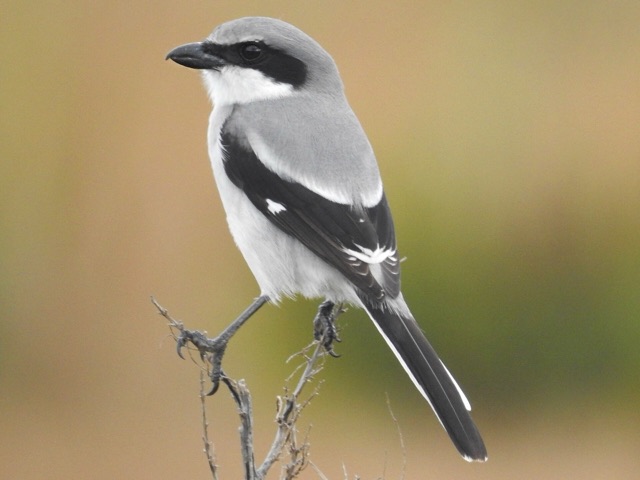

Loggerhead Shrike
Lanius ludovicianus
Here all year.
Recorded by Richard E. Webster. CC BY-NC-SA 4.0, via xeno-canto, trimmed and volume evened out.
Look for
- A black mask across its eyes.
- Mostly gray and white, with black wings and a black tail. When it flies, white marks show on the wings and tail.
- A hooked bill. It often sits on a wire or fence and watches the ground.
A little about it
Loggerhead Shrikes can live here all year. In many places, they start to nest early in spring.
A shrike is a songbird, but it hunts other animals. It watches from a high perch, then swoops down on its food. It uses its hooked bill to kill what it catches. In summer it eats mostly big bugs, like grasshoppers and crickets. It also catches mice and small birds. Now and then it even takes a snake or a lizard.
The nest is a bulky cup of twigs and grass. It's hidden in a thick tree or bush, often a thorny one, usually 5 to 30 feet up. The female lays 5 or 6 eggs. The young leave the nest at about 17 to 21 days old. Then their parents care for them for 3 or 4 more weeks.
There are fewer shrikes in many places than there used to be. They're now gone from the northeast part of the country, and no one is sure why.
Fun fact
A shrike sticks extra food on a thorn or a barbed-wire fence and comes back later to eat it. A male may even bring his mate a snack he saved this way.
When it's here
- January: here
- February: here
- March: here
- April: here
- May: here
- June: here
- July: here
- August: here
- September: here
- October: here
- November: here
- December: here
Taller bars mean more sightings. Most often seen in October.
How big
About 9 inches. About the size of a robin.
Where to look
Open country with a few scattered trees or bushes. In winter it can live where there are no trees at all, as long as there are fences or wires to sit on.
Could it be something else?
Northern Mockingbird
About the same size. It's gray and white too, with white wing patches that show when it flies. Look at the face. A shrike has a black mask, and a mockingbird doesn't.
Where these facts come from
- Audubon Guide to North American Birds
- When it's here: Sightings shared on iNaturalist in the 8 counties, all years.