All birds Woodpeckers
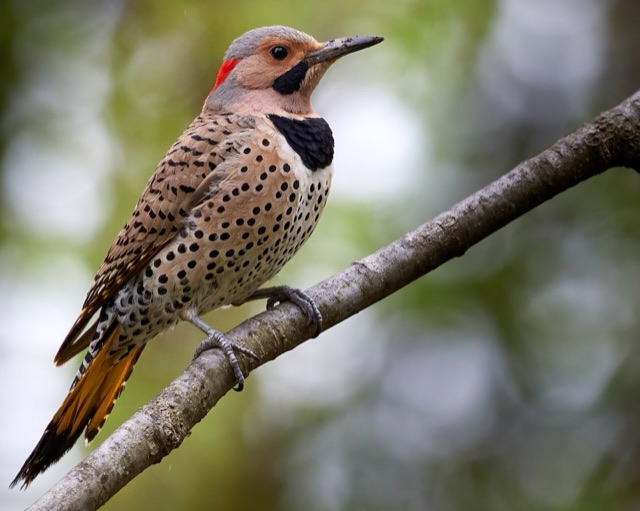

Northern Flicker
Colaptes auratus
Here most of the year.
Recorded by Paul Marvin. CC BY-NC-SA 4.0, via xeno-canto, trimmed and volume evened out.
Look for
- A brown back with thin black bars, and a black patch on the chest.
- Lots of round black spots on the belly. When it flies, look for a white patch above the tail and bright yellow or salmon-pink under the wings.
- Males have a black or red "mustache" stripe on the side of the face. Females don't.
A little about it
You can see flickers here all year, but there are many more from October to March. In winter they often show up in neighborhoods. Flickers that nest far up north, in Canada and Alaska, fly south for the winter.
Flickers are woodpeckers, but they spend lots of time on the ground. They hop along and dig for ants and other bugs. In fall and winter, they eat lots of berries and fallen acorns. At feeders, look for one on the suet.
Listen for a loud "wicka-wicka-wicka" call. In spring, flickers also drum in short bursts. To guard his space, a male swings his head back and forth and flicks his wings open to show off his bright colors.
Both parents dig the nest hole, most often in a dead tree, 6 to 20 feet up. The female lays 5 to 8 white eggs, and the male sits on them at night. The young leave the nest about 4 weeks after they hatch. Sometimes starlings chase flickers away and take their brand-new nest holes.
Fun fact
Flickers probably eat more ants than any other bird in North America. They find lots of them on the ground.
When it's here
- January: here
- February: here
- March: here
- April: here
- May: here
- June: here
- July: here
- August: here
- September: here
- October: here
- November: here
- December: here
Taller bars mean more sightings. Most often seen in December.
How big
11 to 12 inches. A little bigger than a robin.
Where to look
Neighborhoods and woods with open grass nearby. Look on the ground under trees, where it hunts for ants.
People have spotted it at Stinchcomb Wildlife Refuge, Mitch Park, Lake Hefner.
Could it be something else?
Red-bellied Woodpecker
A bit smaller. Its back has black and white zebra stripes, with no brown, and it has no black spots on its belly. Look for red on the top or back of its head.
Where these facts come from
- Oklahoma Department of Wildlife Conservation field guide
- Audubon Guide to North American Birds
- When it's here: Sightings shared on iNaturalist in the 8 counties, all years.