All birds Woodpeckers
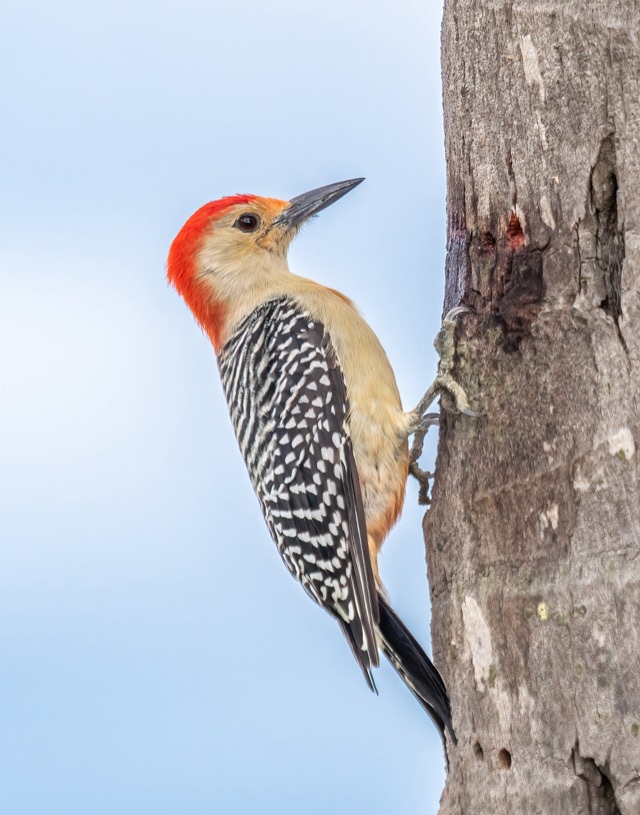

Red-bellied Woodpecker
Melanerpes carolinus
Here all year.
Recorded by Don Blake. CC0, via iNaturalist, trimmed and volume evened out.
Look for
- Black and white zebra stripes across the back.
- Males have red from just above the bill all the way to the back of the neck. Females have red only on the back of the neck.
- A pale tan face and chest. Its red belly is usually hard to see.
A little about it
Red-bellied Woodpeckers don't migrate, so you can see one any month of the year.
It eats bugs, fruit, nuts, and seeds. At some times of year, more than half of its food comes from plants, like acorns. It has even been known to eat tree frogs and small fish! At feeders, it likes suet and black-oil sunflower seeds.
In fall, it tucks nuts and seeds into cracks in tree bark. In winter, it comes back to eat them. Listen for its rolling "churrrr" call.
The nest is a hole it digs in dead wood. That might be a dead tree or even a fence post. The female lays 2 to 6 white eggs, and the male sits on them at night. The young leave the nest about 24 to 27 days after they hatch. Their parents keep feeding them for 6 weeks or more.
Fun fact
A male may start digging several nest holes. The female picks the one she likes, and that's the one they finish.
When it's here
- January: here
- February: here
- March: here
- April: here
- May: here
- June: here
- July: here
- August: here
- September: here
- October: here
- November: here
- December: here
Taller bars mean more sightings. Most often seen in February.
How big
About 9 inches. About as big as a robin.
Where to look
Woods with big trees, especially oaks and trees along creeks. It also lives in neighborhoods with big old trees.
People have spotted it at Lake Thunderbird State Park, Martin Park Nature Center, Oklahoma City Zoo area.
Could it be something else?
Red-headed Woodpecker
Its whole head is red. Its back is solid black, and it has big white patches on its wings. A Red-bellied has zebra stripes on its back and red only on the top and back of its head.
Downy Woodpecker
Much smaller, about the size of a sparrow. It has one wide white stripe down its back. Only the male has red, in a small spot on the back of its head.
Where these facts come from
- Oklahoma Department of Wildlife Conservation field guide
- Audubon Guide to North American Birds
- When it's here: Sightings shared on iNaturalist in the 8 counties, all years.