All birds Ducks, Geese, and Waterfowl
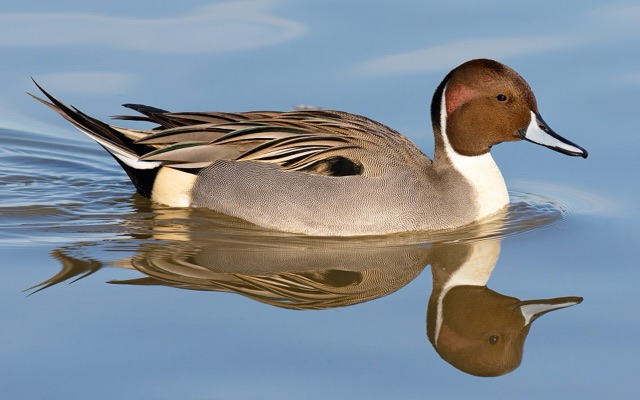

Northern Pintail
Anas acuta
Here October to February.
Recorded by Paul Marvin. CC BY-NC-SA 3.0, via xeno-canto, trimmed and volume evened out.
Look for
- Males have a chocolate brown head. A white stripe runs up the side of the long neck.
- The male's body is gray. His tail ends in long, pointed black feathers.
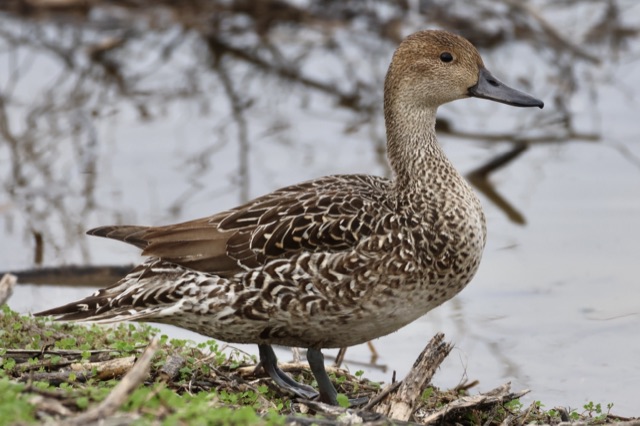
- Females are speckled tan and brown, with a gray bill. Look for the long neck and the pointed tail.
A little about it
Pintails are winter ducks here. You can find them from October to February. They're one of the first ducks to come south in fall, and one of the first to head back north. In winter they gather in big groups.
A pintail tips up to eat, with its tail in the air and its head under the water. Its long neck can reach food on the bottom in water up to 1 foot deep. Other ducks that feed this way can't reach that far. In winter it eats mostly seeds and leftover grain. In summer it eats more bugs and snails.
People call the pintail the "greyhound of the air," after the fast, slim dog. Its long, narrow wings help it fly fast. Pintails are shy and careful all year long.
Pintails nest on dry ground among short plants. The nest can be as far as half a mile from water. The mom lays about 8 eggs, and they hatch in 22 to 24 days. Within a few hours, she leads her babies away from the nest.
Fun fact
Some pintails nest far away in Siberia, in Asia. In fall they fly across the sea to spend the winter in North America.
When it's here
- January: here
- February: here
- March: a few
- April: a few
- May: a few
- June: not here
- July: not here
- August: not here
- September: not here
- October: here
- November: here
- December: here
Taller bars mean more sightings. Most often seen in February.
How big
20 to 25 inches. A bit bigger than a crow, but slim, with a long neck.
Where to look
Shallow water with muddy edges. Check marshes and flooded fields.
People have spotted it at Lake Hefner.
Could it be something else?
Mallard
A female Mallard is speckled brown too, so look at the bill. Hers is orange with black smudges. A female pintail has a gray bill, a long neck, and a pointed tail.
More photos
Where these facts come from
- Oklahoma Department of Wildlife Conservation field guide
- Audubon Guide to North American Birds
- When it's here: Sightings shared on iNaturalist in the 8 counties, all years.