All birds Nuthatches
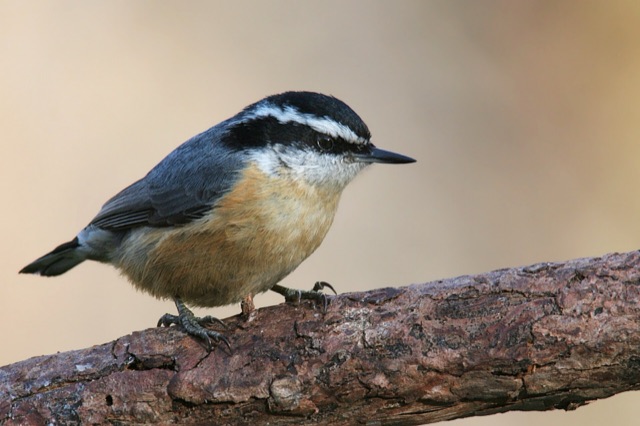

Red-breasted Nuthatch
Sitta canadensis
Here October to April.
Recorded by Christopher McPherson. CC BY-NC-SA 4.0, via xeno-canto, trimmed and volume evened out.
Look for
- A rusty orange chest and belly, with a blue-gray back.
- A black stripe through each eye, with a white stripe above it.
- The top of the head is black on males and gray on females.
A little about it
Red-breasted Nuthatches visit Oklahoma in winter. Look for them from October to April. They're uncommon, and how many come changes a lot from winter to winter. It depends on food and weather.
They nest in evergreen forests up north and high in the mountains. When the seed crop up there is poor, they may fly hundreds of miles south.
It climbs up and down tree trunks and branches to find food. It can even climb down a tree headfirst. In summer it eats mostly bugs and spiders. In winter it eats lots of seeds, especially from pine trees and other evergreens. At feeders, it likes black-oil sunflower seeds and peanuts. It eats suet too.
This little bird often isn't very scared of people. If you stand still near some evergreen trees, one may come very close. Listen for a tinny "yank-yank" call.
Fun fact
It smears sticky sap around the door of its nest hole. The sap may help keep other animals out. The nuthatches fly straight into the hole so they don't get stuck.
When it's here
- January: here
- February: here
- March: here
- April: here
- May: not here
- June: not here
- July: not here
- August: not here
- September: a few
- October: here
- November: here
- December: here
Taller bars mean more sightings. Most often seen in October.
How big
4 to 4.7 inches. A little smaller than a sparrow, with a short tail.
Where to look
Trees in woods and neighborhoods, especially pine trees. It comes to feeders that hang near big trees.
People have spotted it at Lake Thunderbird State Park, Martin Park Nature Center.
Could it be something else?
White-breasted Nuthatch
Bigger, with a white face and a white chest and belly. It has no black stripe through its eye. Its "yank-yank" call is lower than a Red-breasted's.
Where these facts come from
- Oklahoma Department of Wildlife Conservation field guide
- Audubon Guide to North American Birds
- When it's here: Sightings shared on iNaturalist in the 8 counties, all years.