All birds Nuthatches
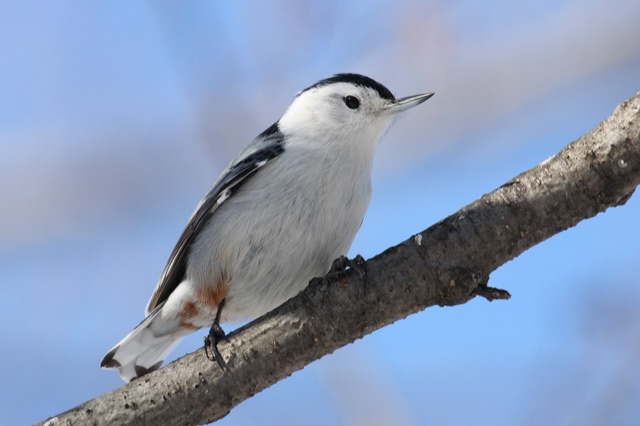

White-breasted Nuthatch
Sitta carolinensis
Here all year.
Recorded by Phoenix Birder. CC BY-NC-SA 4.0, via xeno-canto, trimmed and volume evened out.
Look for
- Blue-gray on the back, and white from the face down to the belly.
- A thin dark stripe on top of the head. It's black on males and often gray on females.
- It often climbs down tree trunks headfirst.
A little about it
White-breasted Nuthatches live here all year. A pair stays on its own patch of trees year-round, and the 2 may stay mates for life.
It climbs all over tree trunks and big branches to look for food. In summer it eats mostly bugs and spiders. In winter, seeds can be more than half of its food. At feeders, it likes black-oil sunflower seeds, peanuts, and suet.
In fall and winter, a nuthatch often grabs a seed and flies off to hide it in a crack in the bark. In winter, it may travel with Carolina Chickadees and Tufted Titmice. Listen for its nasal "yank-yank" call.
The nest is in a hole in a tree, 15 to 60 feet up. It may be a natural hole or an old woodpecker hole. The female lays 5 to 9 eggs. While she sits on them, the male brings her food.
Fun fact
A nuthatch may hold a squashed bug in its bill and sweep it all over its nest, inside and out. Scientists think the bug's juices may help keep hungry animals away.
When it's here
- January: here
- February: here
- March: here
- April: here
- May: here
- June: here
- July: here
- August: here
- September: here
- October: here
- November: here
- December: here
Taller bars mean more sightings. Most often seen in February.
How big
5 to 6 inches. A little bigger than a sparrow, but chunky, with a short tail.
Where to look
Woods and neighborhoods with big old trees, especially oaks. Look on tree trunks and big branches, and at feeders close to tall trees.
People have spotted it at Lake Thunderbird State Park, Martin Park Nature Center.
Could it be something else?
Red-breasted Nuthatch
It has a rusty chest and belly and a black stripe through each eye. A White-breasted has a clean white face.
Carolina Chickadee
Smaller, and it has a black cap too. Look under the bill. A chickadee has a black bib, and a nuthatch's throat is white.
Where these facts come from
- Oklahoma Department of Wildlife Conservation field guide
- Audubon Guide to North American Birds
- When it's here: Sightings shared on iNaturalist in the 8 counties, all years.