All birds Woodpeckers
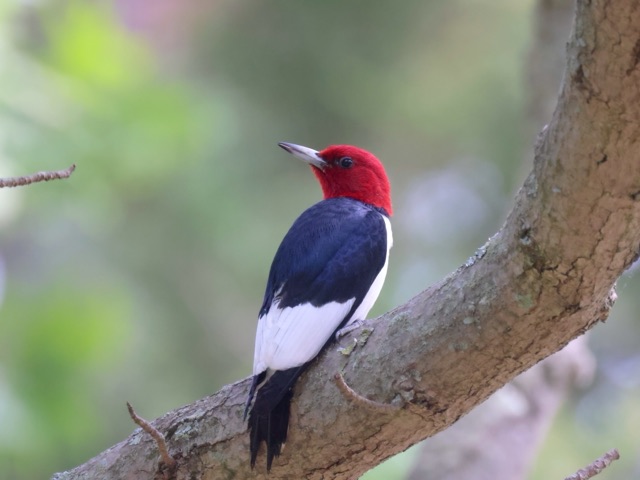
Red-headed Woodpecker
Melanerpes erythrocephalus
Here all year.
Recorded by Andrew Spencer. CC BY-NC-SA 4.0, via xeno-canto, trimmed and volume evened out.
Look for
- The whole head is bright red.
- A solid black back, with a white chest and belly.
- Big white patches on its black wings. They flash when it flies. Males and females look the same.
A little about it
You can find Red-headed Woodpeckers here in any month. How many stay for the winter changes a lot from year to year. It depends on the weather and on how many acorns the oak trees make.
It eats more kinds of food than most woodpeckers. It eats bugs, spiders, earthworms, nuts, seeds, berries, and fruit. It even flies out from a branch to catch bugs in the air. At feeders, it eats suet and black-oil sunflower seeds. It eats raisins too.
In fall, it gathers acorns and other nuts and stuffs them into holes and cracks in trees. In winter, it comes back to eat them. Listen for a loud "churr-churr" call.
The nest is a hole in a dead tree or a dead branch. The female lays 4 or 5 white eggs, and the male sits on them at night. The eggs hatch in just 12 or 13 days. The young leave the nest 27 to 31 days after they hatch.
Fun fact
The male does most of the work digging a new nest hole. If the female likes the spot, she shows him by tapping on the tree.
When it's here
- January: here
- February: here
- March: here
- April: here
- May: here
- June: here
- July: here
- August: here
- September: here
- October: here
- November: here
- December: here
Taller bars mean more sightings. Most often seen in September.
How big
7.5 to 10 inches. About as big as a robin.
Where to look
Open woods with big oak trees, and trees along creeks and ponds. It likes tall trees with open space around them, and it's not common in neighborhoods.
People have spotted it at Arcadia Lake, Lake Thunderbird State Park, Martin Park Nature Center.
Could it be something else?
Red-bellied Woodpecker
It has red only on the top and back of its head. Its back has black and white zebra stripes, and it has no big white patches on its wings.
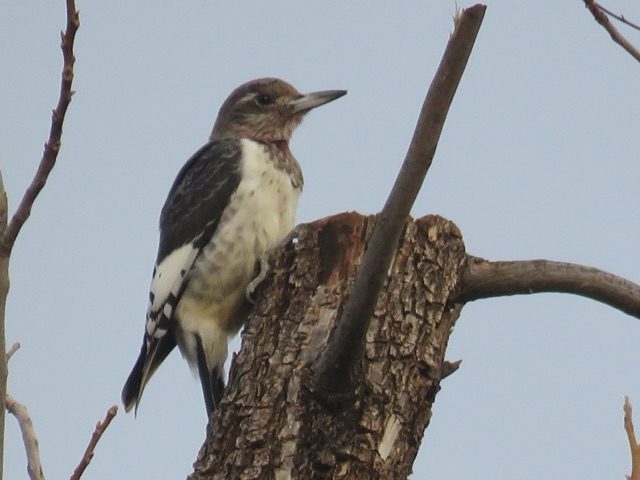
Young Red-headed Woodpecker
Its head is brown, and its white wing patches have dark bars. The brown turns red during its first winter.
More photos
Where these facts come from
- Oklahoma Department of Wildlife Conservation field guide
- Audubon Guide to North American Birds
- When it's here: Sightings shared on iNaturalist in the 8 counties, all years.