All birds Kinglets
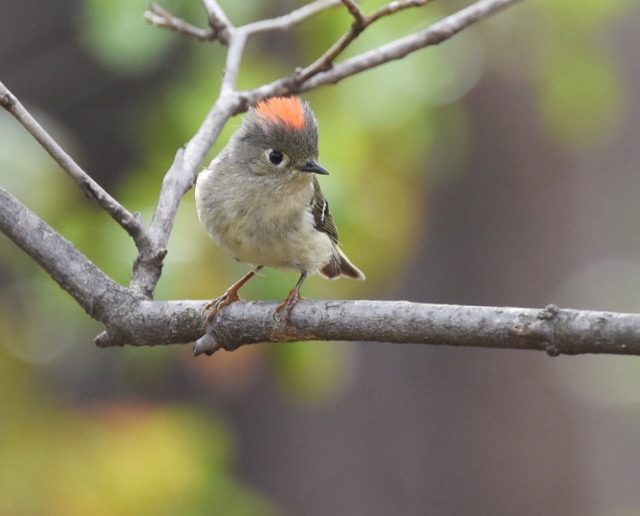

Ruby-crowned Kinglet
Corthylio calendula
Here October to February.
Recorded by Christopher McPherson. CC BY-NC-SA 4.0, via xeno-canto, trimmed and volume evened out.
Look for
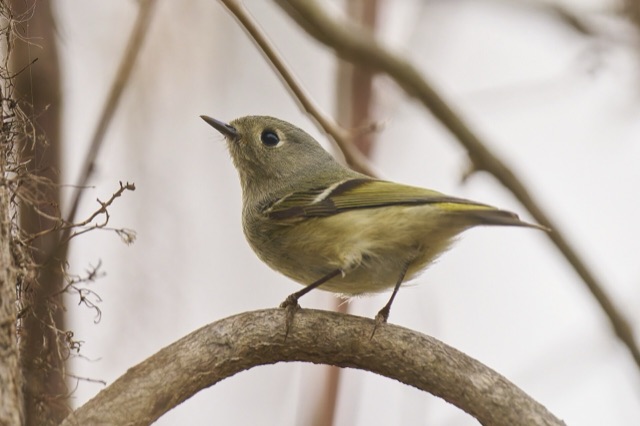
- A tiny, greenish gray bird with a bold white ring around each eye.
- A white stripe across each wing, with a black stripe right behind it.
- Males have a red patch on top of the head. It's usually hidden. He only raises it when he's excited.
A little about it
Kinglets come here for the cold months. October is the best month to look, when lots of them pass through. A few more show up again in April.
It flicks its wings again and again as it hunts. It checks leaves and twigs for tiny bugs and spiders, and sometimes it hovers in the air to pick one off. In winter, it eats some berries and seeds too.
For such a small bird, it has a big, loud song. It sounds like fast, jumbled chatter.
In summer, kinglets live in forests of spruce and fir trees. The female builds a deep cup nest that hangs under a branch, often about 40 feet up.
Fun fact
A kinglet is only about 4 inches long, but it lays a lot of eggs. Most nests have 7 or 8. In the Pacific Northwest, a nest can hold as many as 12.
When it's here
- January: here
- February: here
- March: a few
- April: here
- May: a few
- June: not here
- July: a few
- August: not here
- September: a few
- October: here
- November: here
- December: here
Taller bars mean more sightings. Most often seen in October.
How big
About 4 inches. Smaller than a sparrow, with a short tail.
Where to look
Woods and brushy thickets. In winter it often hunts low, so check the bushes and small trees.
People have spotted it at Stinchcomb Wildlife Refuge, Martin Park Nature Center, Oklahoma City Zoo area.
Could it be something else?
Golden-crowned Kinglet
Just as tiny, with the same wing stripes. It has stripes on its face and no eye ring. The top of its head shows yellow or orange.
Blue-gray Gnatcatcher
Also tiny, with a white ring around each eye. It's blue-gray, with a long tail that has white sides. It's mostly here in spring and summer.
More photos
Where these facts come from
- Audubon Guide to North American Birds
- When it's here: Sightings shared on iNaturalist in the 8 counties, all years.