All birds Gnatcatchers
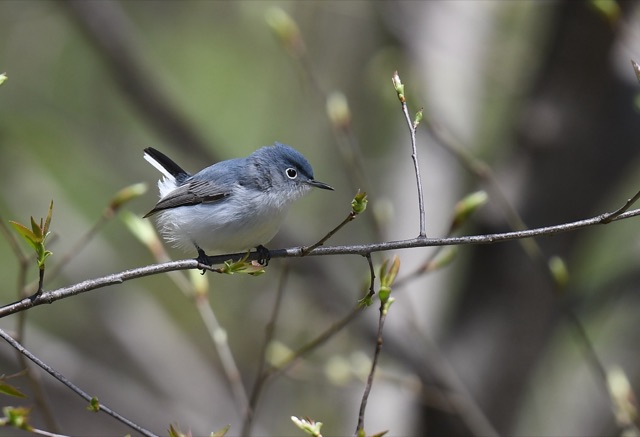
Blue-gray Gnatcatcher
Polioptila caerulea
Here March to September.
Recorded by Matt Wistrand. CC BY-NC-SA 4.0, via xeno-canto, trimmed and volume evened out.
Look for
- Blue-gray on top and whitish below, with a white ring around each eye.
- A long tail with white sides. From below, the tail looks all white.
- In spring and summer, the male has a thin black line over each eye.
A little about it
Gnatcatchers come here in spring and stay for the summer. April is the best month to spot one.
This tiny bird eats small bugs and lots of spiders. Sometimes it hovers to grab a bug off a leaf, or darts out to snap one up in midair. If it catches a big bug, it whacks it on a branch before it eats it.
Listen for its call, a whiny, buzzy "pzzzz." Its song is a thin, musical warble.
Mom and dad build a small cup nest, often on top of a branch 20 to 40 feet up. The female lays 4 or 5 eggs. The babies leave the nest 10 to 15 days after they hatch.
Fun fact
Gnatcatchers cover the outside of their nest with spider webs and bits of lichen. That helps the little nest blend in, so it's very hard to spot.
When it's here
- January: a few
- February: not here
- March: here
- April: here
- May: here
- June: here
- July: here
- August: here
- September: here
- October: a few
- November: a few
- December: a few
Taller bars mean more sightings. Most often seen in April.
How big
About 4 inches. Smaller than a sparrow, with a long tail.
Where to look
Open woods and thickets with leafy trees. Look up in the treetops, where it flits around the leaves.
People have spotted it at Arcadia Lake, Martin Park Nature Center, Lake Thunderbird State Park.
Could it be something else?
Ruby-crowned Kinglet
Also tiny, with a white ring around each eye. It's greenish gray, with a short tail and a white stripe on each wing. It's mostly here in fall and winter.
Northern Mockingbird
Also gray with a long tail that has white sides. It's about twice as long as a gnatcatcher, and it flashes big white wing patches when it flies.
Where these facts come from
- Audubon Guide to North American Birds
- When it's here: Sightings shared on iNaturalist in the 8 counties, all years.