All birds Pheasants, Grouse, and Allies

Wild Turkey
Meleagris gallopavo
Here most of the year.
Recorded by Sue Riffe. CC BY-NC-SA 4.0, via xeno-canto, trimmed and volume evened out.
Look for
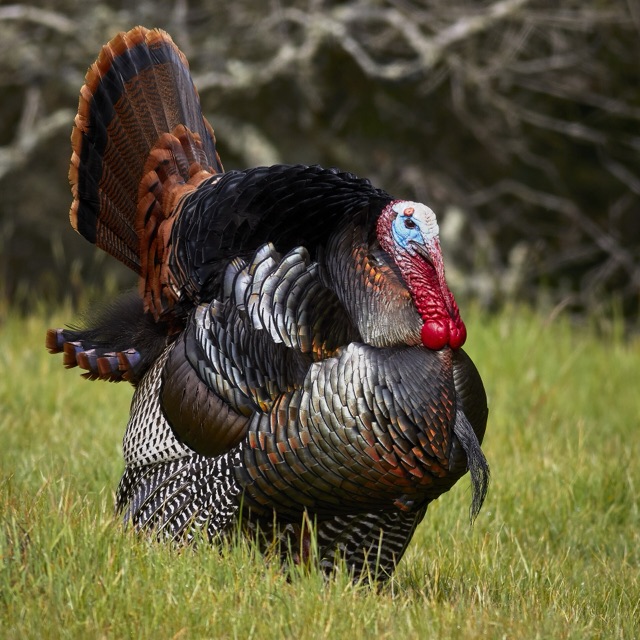
- A huge, dark bird with a long, wide tail. Its small head has bare skin.
- Males shine like metal in the sun. A tuft of feathers called a "beard" sticks out from a male's chest.
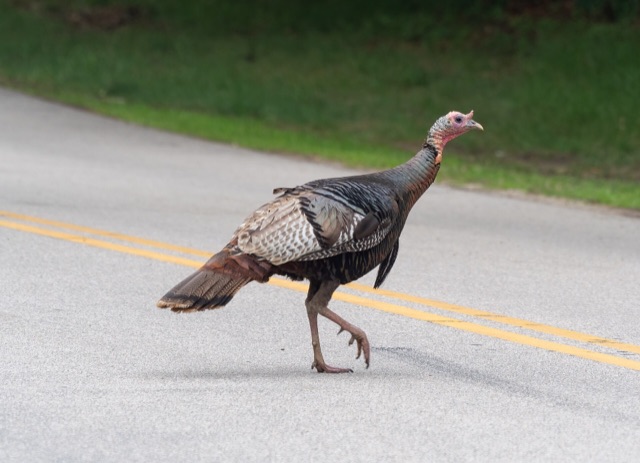
- Females are smaller and duller. They have tiny feathers on the head that help them hide.
A little about it
Wild Turkeys live here all year, and you'll see the most in spring. Most of the turkeys in Oklahoma are a kind called Rio Grande turkeys. They live all over the state, but most of all in the middle and the west.
Turkeys walk on the ground to find food, and they scratch in dead leaves to see what's under them. They eat mostly plants. Acorns are a big favorite, along with seeds, berries, buds, and roots. They also catch bugs and snails, and once in a while a frog or even a snake.
A turkey has eyes on the sides of its head. By turning its neck, it can see all the way around in a circle. It can tell where a sound comes from even a mile away. Turkeys mostly walk or run, but they fly well too. At night they sleep up in tall trees.
In spring, males gobble to call the females. A male puffs out his feathers, fans his tail, and drags his wings on the ground. His head turns bright red, and a flap of skin over his bill gets longer. The female makes her nest in a dip on the ground and lays about 10 to 12 eggs. The chicks leave the nest within a day of hatching and find their own food.
Fun fact
A grown turkey has 5,000 to 6,000 feathers. Benjamin Franklin would have liked the turkey to be the bird for the whole country.
When it's here
- January: here
- February: here
- March: here
- April: here
- May: here
- June: here
- July: here
- August: here
- September: here
- October: here
- November: here
- December: here
Taller bars mean more sightings. Most often seen in March.
How big
Almost 4 feet, with wings more than 4 feet across. Bigger than a goose. A big male can stand 4 feet tall.
Where to look
Brushy land near creeks and rivers, with trees and open spots mixed together. Look for a flock walking along the edge of a field.
People have spotted it at Lake Thunderbird State Park, Arcadia Lake, Lake Stanley Draper.
Could it be something else?
Turkey Vulture
Also big and dark with a bare red head. You'll usually see a vulture soaring high in the sky with its wings held up in a shallow V. Turkeys spend most of their time walking on the ground.
More photos
Where these facts come from
- Oklahoma Department of Wildlife Conservation field guide: Rio Grande Turkey
- Oklahoma Department of Wildlife Conservation field guide: Eastern Turkey
- Audubon Guide to North American Birds
- When it's here: Sightings shared on iNaturalist in the 8 counties, all years.