All birds Ducks, Geese, and Waterfowl
Wood Duck
Aix sponsa
Here all year.
Recorded by Russ Wigh. CC BY-NC-SA 4.0, via xeno-canto, trimmed and volume evened out.
Look for
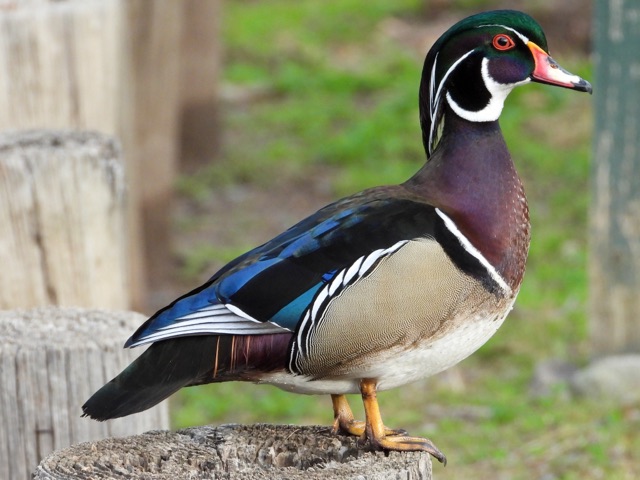
- Males have a shiny green head and crest, with white stripes on the face and neck.
- The male has red eyes and a red bill with a yellow patch at the base. His chest is a rich reddish brown.
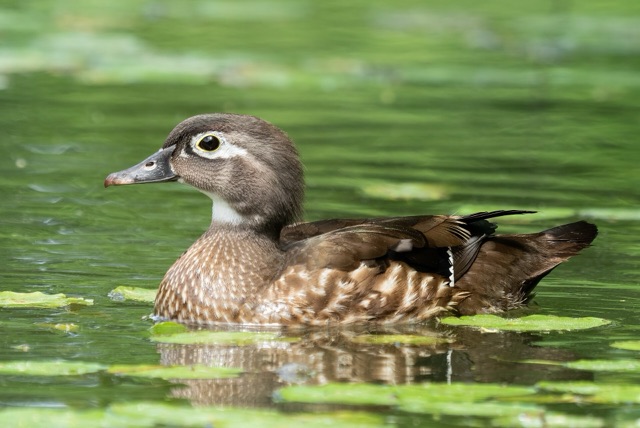
- Females are gray-brown with a white teardrop shape around each eye. They have a small crest too. For part of the year, males look a lot like females.
A little about it
You can see Wood Ducks here all year. They have sharp claws, so they can perch up in trees. Most ducks in North America can't do that.
Wood Ducks feed at the top of the water. They dip their head and neck under, and sometimes tip all the way up. Plants make up about 80 percent of their food. In many places they eat lots of acorns. They also eat seeds, plus some bugs and snails.
They nest in holes in big trees near water, up to 65 feet high. They use nest boxes too. The mother lays 9 to 14 eggs and keeps them warm by herself. She takes care of the ducklings for 5 to 6 weeks.
More than 100 years ago, Wood Ducks almost disappeared. Too much hunting and too few nest trees were to blame. New laws and nest boxes helped them come back, and now there are lots of them again.
Fun fact
Ducklings stay in the tree hole until the morning after they hatch. Then they use their sharp claws to climb up to the opening, and they jump out to the ground.
When it's here
- January: here
- February: here
- March: here
- April: here
- May: here
- June: here
- July: here
- August: here
- September: here
- October: here
- November: here
- December: here
Taller bars mean more sightings. Most often seen in September.
How big
17 to 20 inches. About as big as a crow.
Where to look
Ponds, slow rivers, and swamps with lots of trees around them. Look in the shade where big trees hang over the water.
People have spotted it at Myriad Botanical Gardens, Oklahoma City Zoo area, Martin Park Nature Center.
Could it be something else?
Mallard
A female Mallard is brown and blotchy, and her orange bill has black smudges. A female Wood Duck is grayer, with a small crest and white around her eye.
Hooded Merganser
The female also has a crest and likes wooded ponds. Her crest is bushy and sits at the back of a long, flat head. She dives under the water to catch fish.
More photos
Where these facts come from
- Oklahoma Department of Wildlife Conservation field guide
- Audubon Guide to North American Birds
- When it's here: Sightings shared on iNaturalist in the 8 counties, all years.