All birds Cuckoos
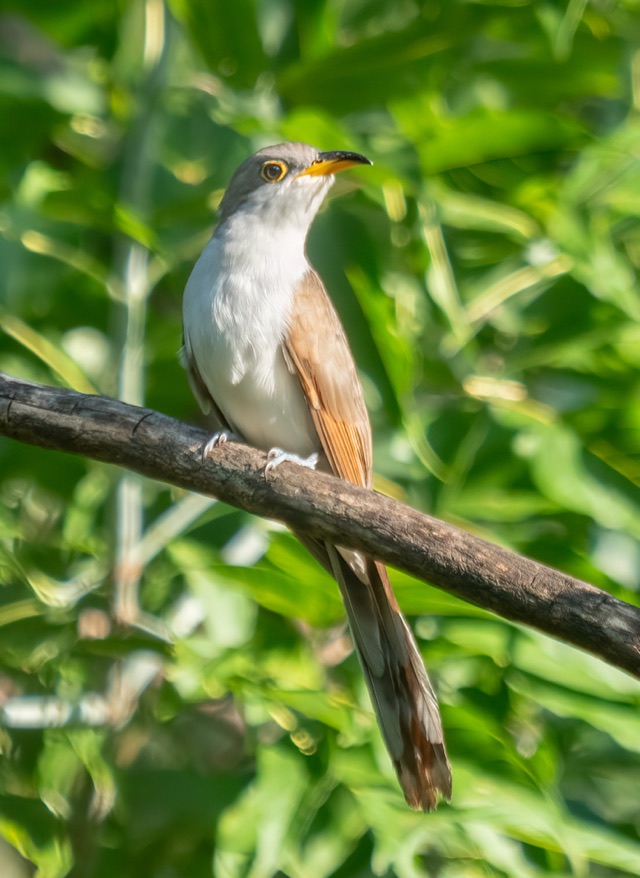

Yellow-billed Cuckoo
Coccyzus americanus
Here May to August.
Recorded by Paul Driver. CC BY-NC-SA 4.0, via xeno-canto, trimmed and volume evened out.
Look for
- A long tail. From below, it looks black with big white spots.
- Rusty red on the wings. You'll see it best when the bird flies.
- Yellow on the bottom half of its bill. You need to be close to see it.
A little about it
Yellow-billed Cuckoos come here in summer to nest. They show up late in spring and leave early in fall. Some fly all the way to Argentina for the winter.
Caterpillars are its main food, even the hairy kind. It also eats cicadas, beetles, grasshoppers, and katydids. Once in a while it eats a lizard or a frog. It eats some berries too. It climbs around in bushes and trees and picks bugs off the leaves.
Listen on hot summer days for a loud, rattling call: "ka-ka-ka-ka-kow-kow-kowp, kowp, kowp." It slows down at the end. You can hear it from far away.
The nest is a small, loose pile of twigs, most often 4 to 10 feet up. The eggs are pale blue-green, and they hatch in just 9 to 11 days. After about a week, the young climb out of the nest and into the branches. They can fly at about 3 weeks old.
Fun fact
Some people call this bird the "rain crow." Its calls often ring out on hot, sticky afternoons, and people thought it was calling for rain.
When it's here
- January: not here
- February: not here
- March: a few
- April: a few
- May: here
- June: here
- July: here
- August: here
- September: a few
- October: here
- November: not here
- December: not here
Taller bars mean more sightings. Most often seen in June.
How big
10 to 12 inches. About as big as a robin, with a long tail.
Where to look
Thick, leafy trees and tall thickets, like the edges of woods and willows near a marsh. It's easier to hear than to see.
People have spotted it at Martin Park Nature Center, Lake Thunderbird State Park.
Could it be something else?
Mourning Dove
About the same size, with a long tail that has white spots on the edges. A dove has black spots on its wings and no rusty red. It spends lots of time on the ground, while a cuckoo hides up in leafy trees.
Black-billed Cuckoo
Another cuckoo that looks a lot like this one. Its bill is all black, and its wings have no rusty red. From below, its tail is gray with narrow white spots.
Where these facts come from
- Audubon Guide to North American Birds
- When it's here: Sightings shared on iNaturalist in the 8 counties, all years.