All birds New World Warblers
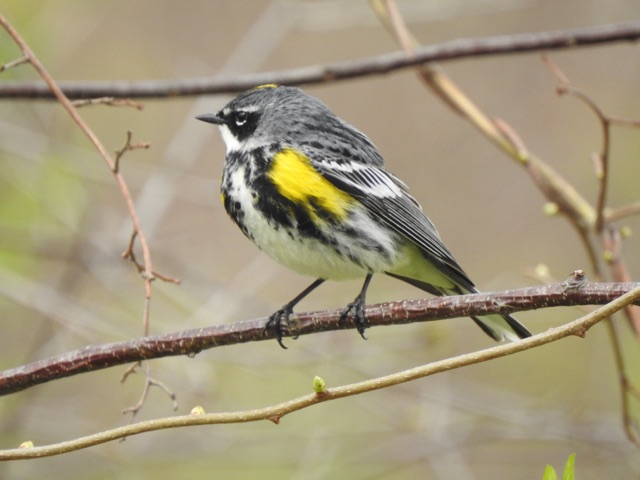
Yellow-rumped Warbler
Setophaga coronata
Here October to April.
Recorded by Christopher McPherson. CC BY-NC-SA 4.0, via xeno-canto, trimmed and volume evened out.
Look for
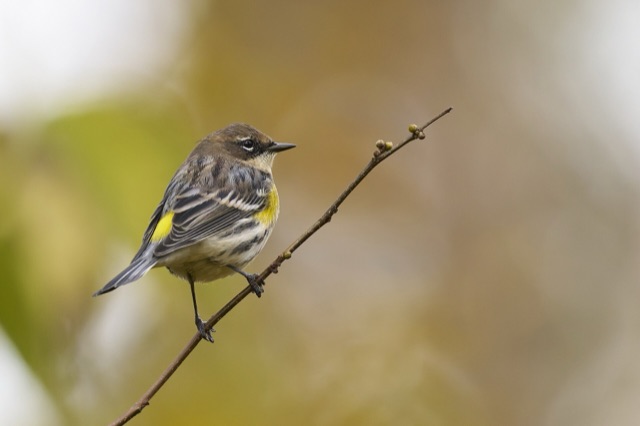
- A bright yellow patch on its rump, just above the tail. You'll see it best when the bird flies away.
- A small yellow patch on each side of the chest, and white spots in the tail.
- Many have a white throat and a dark patch on the cheek. Spring males are the brightest. Young females in fall and winter are the dullest.
A little about it
Yellow-rumped Warblers spend the winter here. Look for them from October to April. December has the most.
They eat lots of bugs, like caterpillars, gnats, beetles, and wasps. They eat spiders too. In winter, they also eat berries from plants like juniper and poison ivy.
This warbler finds food in many ways. It picks bugs off twigs and leaves, and it can hover in the air to grab one. It may also cling to a tree trunk or look for food on the ground. Listen for its sharp "chek!" call.
In summer, they nest up north and in high western mountains, in forests of pine, fir, and spruce. The female lines her cup nest with feathers. The feathers curl over the 4 or 5 eggs and help cover them.
Fun fact
Most warblers fly to the tropics for the winter. Yellow-rumps can stay farther north, because they can digest the wax on waxy berries.
When it's here
- January: here
- February: here
- March: here
- April: here
- May: a few
- June: not here
- July: a few
- August: a few
- September: a few
- October: here
- November: here
- December: here
Taller bars mean more sightings. Most often seen in December.
How big
5 to 6 inches. About the size of a sparrow.
Where to look
In winter, look in open woods and brushy thickets. They visit gardens too. They often hunt for food in flocks.
People have spotted it at Martin Park Nature Center, Lake Stanley Draper, Arcadia Lake.
Could it be something else?
"Audubon's" Yellow-rumped Warbler
This western type has a yellow throat and a plainer face. It has the same yellow rump.
American Goldfinch
In winter, goldfinches are brownish with a little yellow too. But their yellow is on the face and throat, and their black wings have bold white stripes.
More photos
Where these facts come from
- Audubon Guide to North American Birds
- When it's here: Sightings shared on iNaturalist in the 8 counties, all years.