All birds Falcons and Caracaras
American Kestrel
Falco sparverius
Here most of the year.
Recorded by Jonathon Jongsma. CC BY-SA 4.0, via xeno-canto, trimmed and volume evened out.
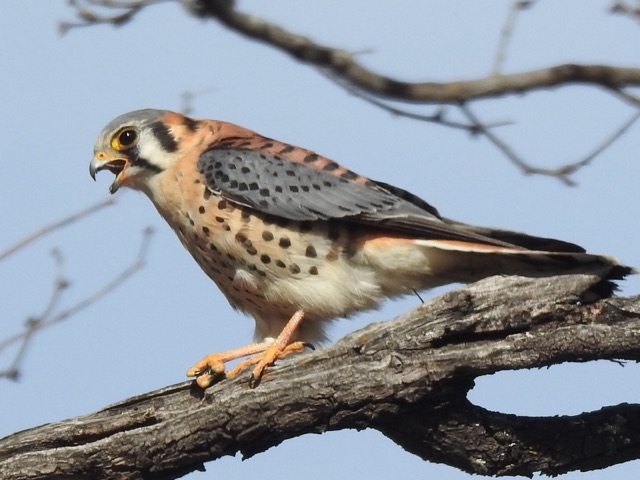
Look for
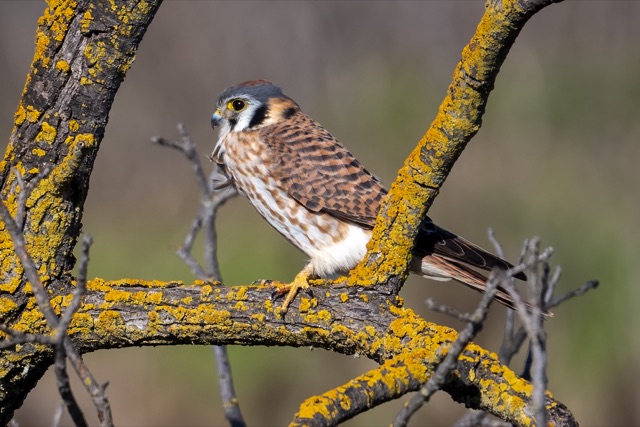
- Bold black stripes on a white face. One looks like a mustache.
- Males have blue-gray wings and a rusty back. The rusty tail has a black tip.
- Females are rusty brown on top, with thin dark bars all over, even on the tail.
A little about it
This is the smallest falcon in North America. Some people call it the "sparrow hawk." You can find a few kestrels here in summer, but there are many more from September to March. Kestrels from up north fly south for the winter.
Kestrels eat mostly big bugs, and grasshoppers are a favorite. They also catch mice, small birds, lizards, and even bats. A kestrel likes to watch from a high perch, then swoop down. When there's no good perch, it hovers over a field on fast-flapping wings.
Kestrels nest in holes, like hollow trees and old woodpecker holes. They'll use a crack in a building or a nest box too. The female does most of the work of keeping the eggs warm, for about 4 weeks. The chicks hatch white or gray. About 3 weeks later, their rusty feathers grow in. They can fly when they're about a month old.
Listen for a sharp "killy-killy-killy." There are fewer kestrels now than there were in 1966. Many places don't have enough old trees with holes, so nest boxes help.
Fun fact
When a male kestrel wants a mate, he brings her food. He hands it to her while they're both flying.
When it's here
- January: here
- February: here
- March: here
- April: here
- May: here
- June: here
- July: here
- August: here
- September: here
- October: here
- November: here
- December: here
Taller bars mean more sightings. Most often seen in January.
How big
9 to 12 inches. About as big as a robin, with long, pointed wings.
Where to look
Open fields and farms, and the edges of town. Look for one sitting on a power line or a fence along the road.
People have spotted it at Lake Hefner.
Could it be something else?
Mourning Dove
Doves sit on power lines too, and they're about the same size. A dove is plain tan with a small head. A kestrel has a hooked bill and black stripes on its face.
Cooper's Hawk
It's blue-gray on top too, but it's much bigger, about the size of a crow. It has a dark cap and a reddish chest. It hunts by sneaking through trees.
More photos
Where these facts come from
- Oklahoma Department of Wildlife Conservation field guide
- Audubon Guide to North American Birds
- When it's here: Sightings shared on iNaturalist in the 8 counties, all years.