All birds Treecreepers
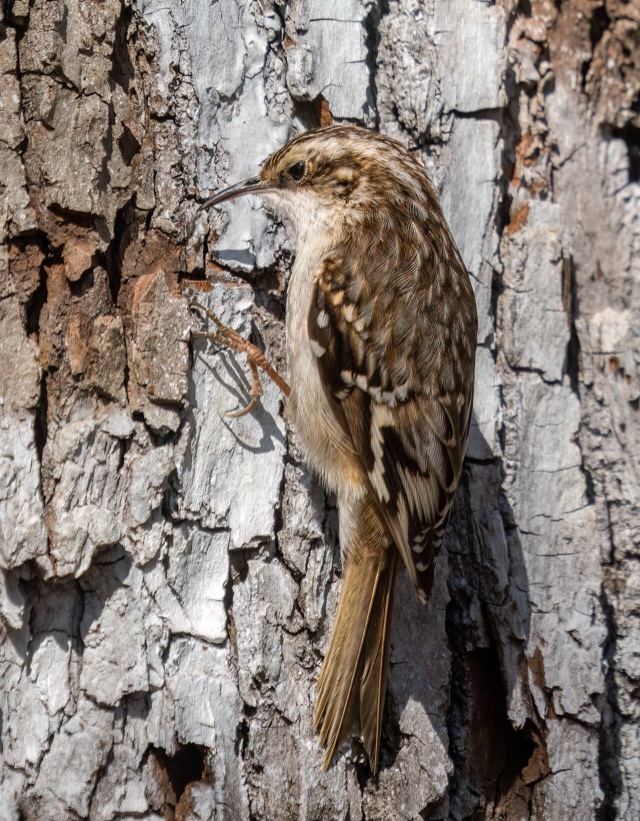

Brown Creeper
Certhia americana
Here October to March.
Recorded by Jacob Saucier. CC BY-NC-SA 4.0, via xeno-canto, trimmed and volume evened out.
Look for
- A streaky brown back that looks a lot like tree bark.
- A white throat and belly, with a pale stripe over the eye.
- A thin bill that curves down a little, and a long, pointed tail. Males and females look alike.
A little about it
Brown Creepers come here for the cold months. Look for them from October to March. In summer, they nest up north and in the Rocky Mountains.
It hunts by creeping up a tree trunk, slow and steady. It presses its long tail against the bark to hold itself up, like a 3rd leg. So it can only climb up. When it reaches the top, it flies down to the bottom of another tree and starts again.
It pokes into cracks in the bark for tiny bugs and their eggs. It eats spiders too. It rarely visits feeders, but a suet feeder on a tree trunk is your best chance.
Most of the time you'll see just 1, or a small group of fewer than 5. It sometimes travels with chickadees and nuthatches. Listen for a high, thin "tsee." That call is often your first clue that one is near.
Fun fact
A Brown Creeper hides its nest behind a loose strip of bark that's still on the tree. The nest is shaped to fit that skinny space.
When it's here
- January: here
- February: here
- March: here
- April: not here
- May: not here
- June: not here
- July: not here
- August: not here
- September: not here
- October: here
- November: here
- December: here
Taller bars mean more sightings. Most often seen in February.
How big
About 5 inches. A little smaller than a sparrow.
Where to look
Woods with big, old trees, most of all along creeks and rivers. A few visit parks and yards that have tall trees.
People have spotted it at Lake Thunderbird State Park, Martin Park Nature Center.
Could it be something else?
White-breasted Nuthatch
It climbs trees too, but it's blue-gray on top. A nuthatch can go down a tree. A creeper only goes up.
Carolina Wren
Also brown. A wren often holds its tail up in the air. A creeper keeps its tail pressed down on the tree trunk.
Where these facts come from
- Oklahoma Department of Wildlife Conservation field guide
- Audubon Guide to North American Birds
- When it's here: Sightings shared on iNaturalist in the 8 counties, all years.