All birds Troupials and Allies
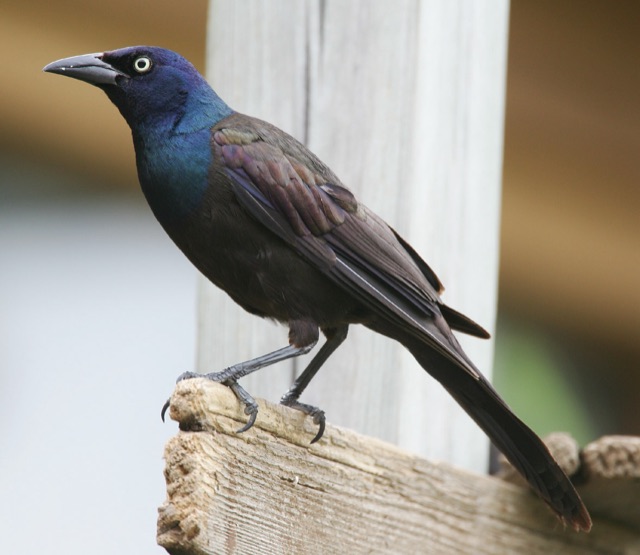

Common Grackle
Quiscalus quiscula
Here most of the year.
Recorded by Joe Weiss. CC BY-NC-SA 4.0, via xeno-canto, trimmed and volume evened out.
Look for
- Males are glossy black. In the sun, the head shines purple-blue and the back and sides shine bronze.
- Females are smaller and duller brown. Both have pale yellow eyes and a long, dark bill.
- A long tail with a crease down the middle. It's shaped like the rudder that steers a boat.
A little about it
You can see Common Grackles here most of the year. They're easiest to find in March and April. In late summer and early fall, they're hard to find.
Grackles walk across lawns with slow, careful steps, looking for bugs. They eat almost anything. In summer they eat lots of bugs, like grubs and grasshoppers. In winter they eat mostly grain and seeds. They catch crayfish, frogs, and even mice too. At feeders they like cracked corn, millet, and sunflower seeds.
When they aren't nesting, grackles feed in flocks with other blackbirds. In the evening, big flocks fly over on their way to sleep together in trees. Sometimes a grackle steals food from a robin. Its call is harsh and squeaky, like a rusty hinge.
Grackles nest in small groups, often 10 to 30 pairs. The female builds a bulky cup of weeds, grass, and twigs, usually with some mud. She sits on the eggs by herself for about 2 weeks. Both parents feed the babies, mostly bugs. The young leave the nest 10 to 17 days after they hatch.
Fun fact
Grackles sometimes nest in odd places. Some have built a nest in the bottom part of an Osprey nest while the Ospreys were still using it.
When it's here
- January: here
- February: here
- March: here
- April: here
- May: here
- June: here
- July: here
- August: a few
- September: a few
- October: a few
- November: here
- December: here
Taller bars mean more sightings. Most often seen in March.
How big
11 to 13 inches. Bigger than a robin, with a long tail.
Where to look
Lawns, parks, farm fields, and the edges of ponds and creeks. They nest and sleep in thick trees close to open ground.
People have spotted it at Martin Park Nature Center, Lake Hefner, Lake Overholser.
Could it be something else?
Great-tailed Grackle
Much bigger. A male's tail is very long and wide, and he shines blue-purple all over, with no bronze. Females are brown, with a pale stripe over the eye.
European Starling
Smaller, with a short tail and a thin, straight bill. In fall and winter it's covered in white spots.
Where these facts come from
- Oklahoma Department of Wildlife Conservation field guide
- Audubon Guide to North American Birds
- When it's here: Sightings shared on iNaturalist in the 8 counties, all years.