All birds Pigeons and Doves
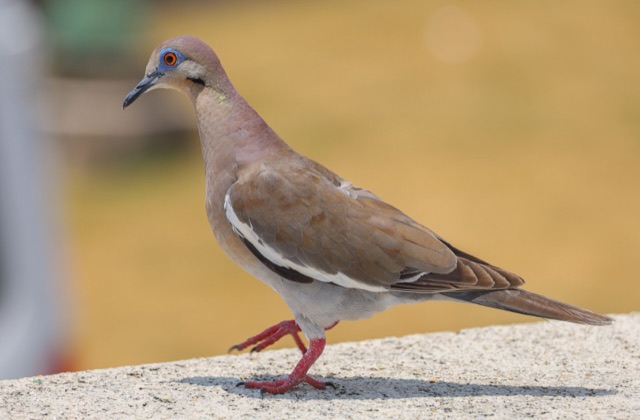

White-winged Dove
Zenaida asiatica
Here all year.
Recorded by Chris Harrison. CC BY-NC-SA 3.0, via xeno-canto, trimmed and volume evened out.
Look for
- A chunky, gray-brown dove. Males and females look alike.
- Big white patches on its wings. They're easiest to see when it flies.
- A short, square tail. The outside feathers have white tips.
A little about it
These doves came up from Texas and places farther south. They used to be common only in the southwest part of Oklahoma. Now you can find them all over the state.
You can see White-winged Doves here all year. The most show up from July to September. Many of them spend the winter in Mexico and Central America. The ones that stay north for the winter live mostly in towns.
They eat seeds, grain, berries, and even acorns. They feed mostly on the ground, but they'll eat up in trees too. Listen for a hooting song that sounds like "who-cooks-for-you."
The male picks the general area for a nest. Then the female picks the exact spot in a tree. In town, they like big shade trees, like pecans. The nest is a thin, floppy pile of sticks. The male brings most of the sticks, and the female builds. She lays 1 or 2 eggs, and both parents feed the babies "pigeon milk." A pair can raise 2 or 3 families in 1 year.
Fun fact
Out in the desert, this dove drinks nectar from the flowers of the giant saguaro cactus. It's an important helper for the cactus, because it carries pollen from flower to flower.
When it's here
- January: here
- February: here
- March: here
- April: here
- May: here
- June: here
- July: here
- August: here
- September: here
- October: here
- November: here
- December: here
Taller bars mean more sightings. Most often seen in July.
How big
11 to 12.5 inches. A little bigger than a robin, and chunkier than a Mourning Dove.
Where to look
Towns and neighborhoods with big shade trees, and farm fields after the harvest. They come to bird feeders too.
People have spotted it at Myriad Botanical Gardens, Martin Park Nature Center, Lake Hefner.
Could it be something else?
Mourning Dove
Smaller and slimmer, with a long, pointed tail. It has black spots on its wings where a White-winged Dove has big white patches.
Eurasian Collared-Dove
About the same size, but paler, with a thin black ring on its neck. Its big white patches are on its tail. A White-winged Dove's are on its wings.
Where these facts come from
- Oklahoma Department of Wildlife Conservation field guide
- Audubon Guide to North American Birds
- When it's here: Sightings shared on iNaturalist in the 8 counties, all years.