All birds Woodpeckers
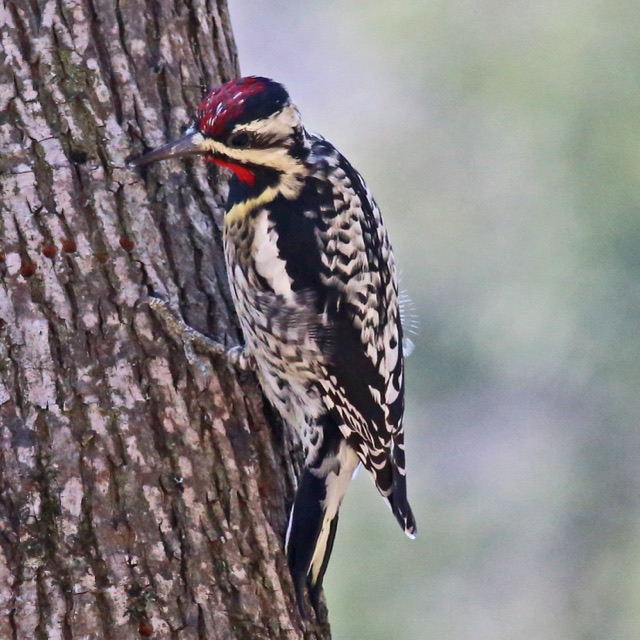
Yellow-bellied Sapsucker
Sphyrapicus varius
Here October to March.
Recorded by Antonio Xeira. CC BY-NC-SA 4.0, via xeno-canto, trimmed and volume evened out.
Look for
- A red forehead, and a face with bold black and white stripes.
- A long white stripe down the side of each folded wing.
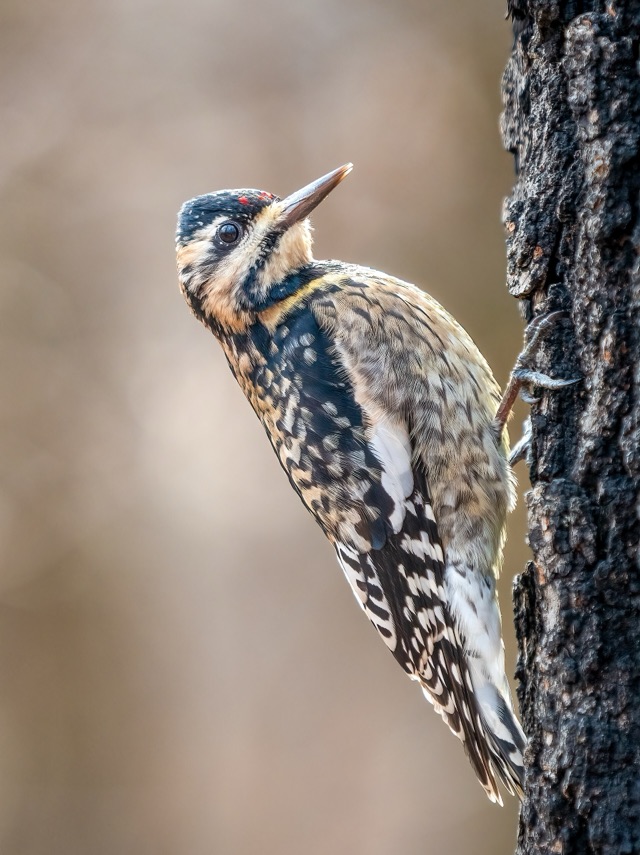
- Males have a red throat, and females have a white one. Both have a black patch on the chest and a pale yellow belly.
A little about it
Sapsuckers are winter birds here. They come in October and leave by early April, and February has the most. In summer they nest far up north, in Canada and the northern United States.
A sapsucker drills rows of tiny holes in tree bark. Sweet sap leaks out, and the bird comes back later to lick it up. Its tongue has a brushy tip that helps.
It also eats bugs that get stuck in the sap, especially ants. In winter, fruit and berries are a big part of its food too.
Sapsuckers are quiet in winter. In spring they get noisy, with mewing calls like a cat. The parents teach their young how to drink sap.
Fun fact
Other animals drink from a sapsucker's holes. Squirrels, chipmunks, bats, and even hummingbirds have been seen sipping the sap.
When it's here
- January: here
- February: here
- March: here
- April: a few
- May: not here
- June: not here
- July: not here
- August: not here
- September: not here
- October: here
- November: here
- December: here
Taller bars mean more sightings. Most often seen in February.
How big
7 to 9 inches. A bit smaller than a robin.
Where to look
Trees in woods and yards, especially trees with sweet sap like pecans and maples. Look for neat rows of tiny holes in the bark.
People have spotted it at Lake Thunderbird State Park, Martin Park Nature Center, Arcadia Lake.
Could it be something else?
Red-bellied Woodpecker
It also has red on its head and black and white bars on its back. But its face and chest are plain pale tan. A sapsucker has a striped face, a black patch on its chest, and a long white stripe on each wing.
Downy Woodpecker
Smaller, with one wide white stripe down the middle of its back. Only the male has red, in a small spot on the back of his head. A sapsucker's red is on its forehead.
More photos
Where these facts come from
- Oklahoma Department of Wildlife Conservation field guide
- Audubon Guide to North American Birds
- When it's here: Sightings shared on iNaturalist in the 8 counties, all years.